You are not bad with money. The math is just genuinely broken.
The old rule was that housing should cost about 30% of what you make. That number is not arbitrary, it is what lenders and housing agencies have used for decades to decide what counts as affordable. Half of American renters are now over that line.
Half of renters are cost burdened. Not a niche group. Half.
Harvard's Joint Center for Housing Studies tracks this every year. In their most recent numbers, 22.6 million renter households were spending more than 30% of their income on housing. That is 50% of everyone renting in the country.
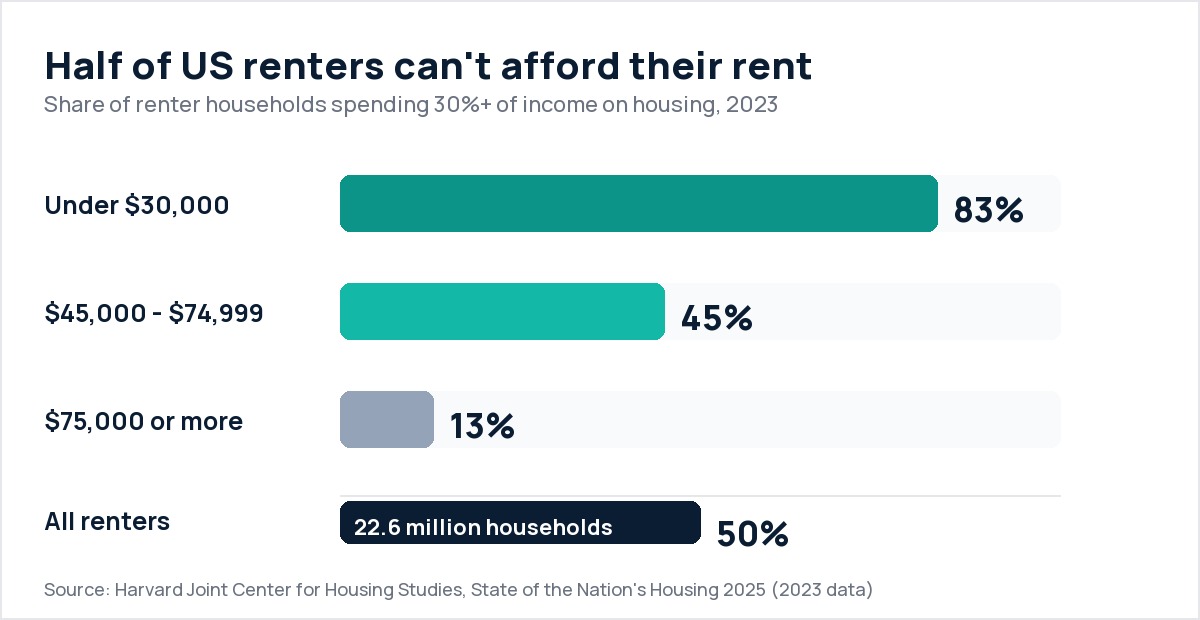
Look at the middle bar, because that is the part people miss. Cost burden is not only a low income problem anymore. Among renters earning between $45,000 and $74,999, the share who are cost burdened has doubled since 2001, to 45%. That is a normal salary. That is a teacher, a nurse, a first job in tech support.
At the bottom it is worse in a way that is hard to read about. Among renters making under $30,000 a year, 83% are cost burdened, and after they pay housing they have around $250 left for the entire rest of their life. Food, transport, medicine, everything.
Why it got like this
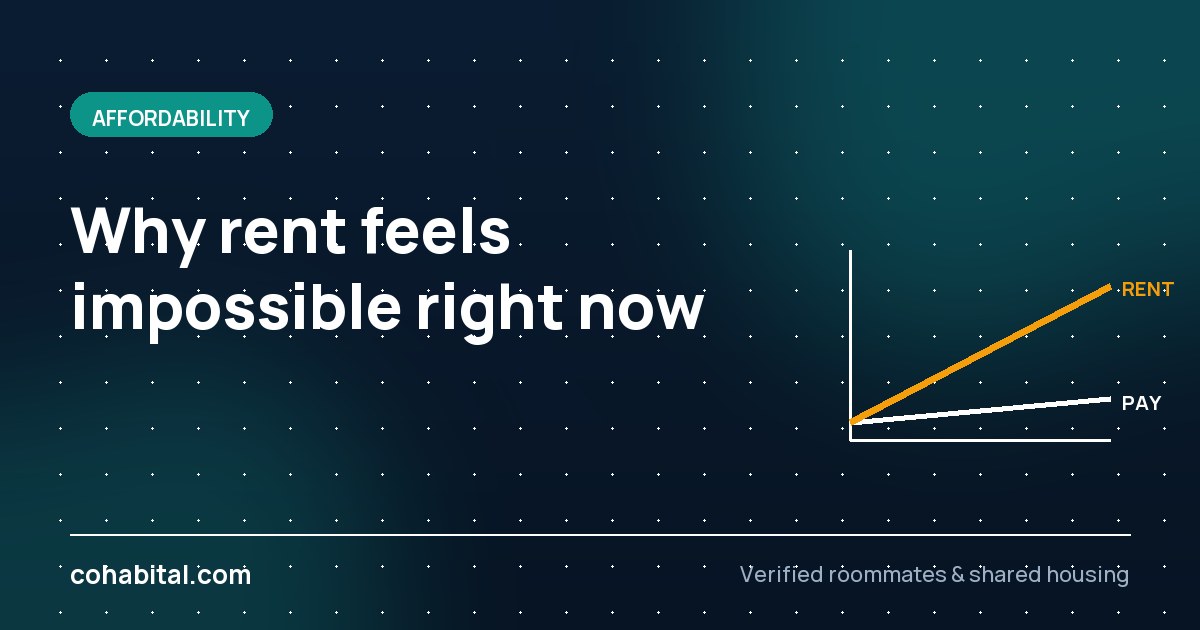
Short version: we did not build enough, and what did get built was mostly expensive. Rents climbed faster than wages for most of the last two decades, and the gap compounds. Meanwhile the size of the average new apartment shrank while the price went up.
You cannot fix that yourself. You cannot budget your way out of a market that structurally does not have enough homes in it. Anyone telling you to just cut out coffee is not being serious about numbers this large.
The one lever you actually control
Here is the thing nobody frames as a strategy, because it is old and unglamorous: sharing is the single biggest housing cost reduction available to a normal person. Not a tax credit, not a lottery for an affordable unit with a four year waitlist. Just splitting a place.
In Seattle, the average one bedroom runs about $1,970 a month. Rooms currently listed on Cohabital in Seattle sit between $850 and $1,300.
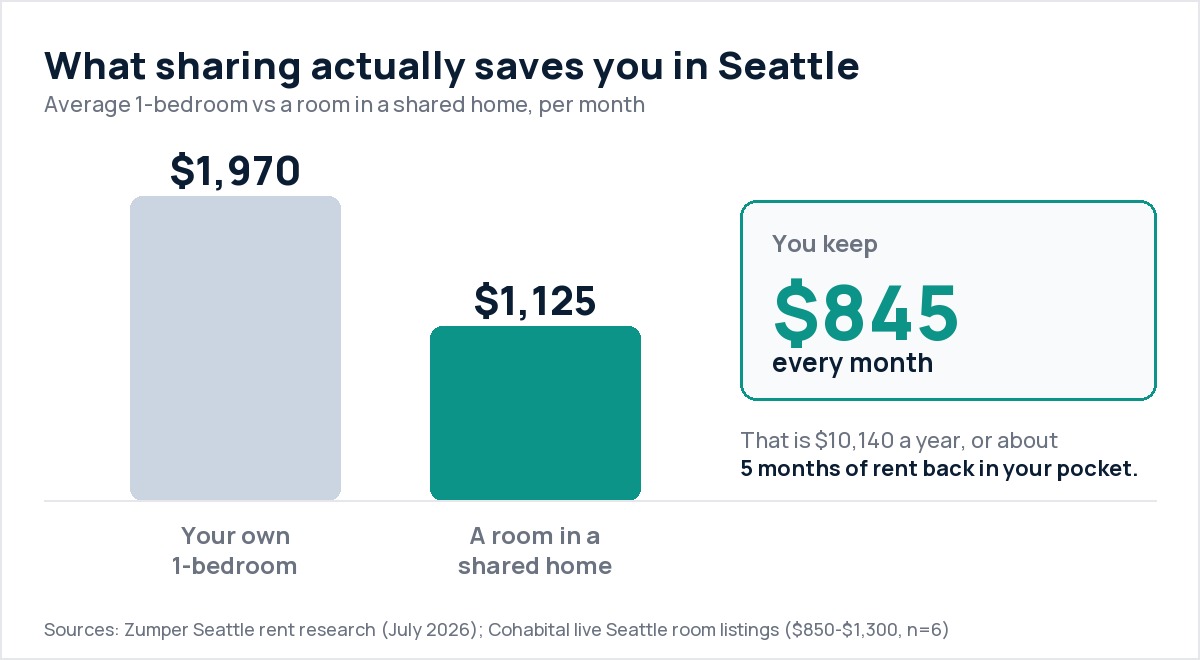
That gap is $845 a month. Over a year it is $10,140. For most people that is more than any raise they are going to get, and it arrives immediately instead of after a performance review.
It is also the difference between being cost burdened and not. Someone earning $50,000 a year hits the 30% line at $1,250 a month. A one bedroom at $1,970 puts them at 47% of income. A room at $1,125 puts them at 27%. Same person, same salary, one decision.
So why doesn't everyone just do it
Because sharing has a trust problem, and the trust problem is expensive.
The reason people pay an $845 a month premium to live alone is not that they love paying it. It is that the alternative means finding a stranger on the internet and hoping. Hoping they are real. Hoping they pay their share. Hoping they are not going to make your home miserable.
Every horror story you have heard makes that premium feel reasonable. And the platforms most people use for this are genuinely bad at it. Anyone can post anything, nobody checks who is real, and you are left doing detective work on a stranger's Instagram at midnight.
What we are actually trying to fix
Cohabital is built on the idea that if you lower the risk of sharing, more people can afford to live where they want. Concretely:
- ID verification. Members can verify a real government ID with a live face check. You can filter your entire search to verified people only, so the "is this person even real" question is off the table before you start
- Compatibility matching. We score the things that actually cause people to move out early: budget, cleanliness, sleep schedule, pets, smoking, guests. A hard mismatch on pets or smoking gets flagged instead of averaged away
- Reviews from people who actually lived with them. Not vibes, not a follower count
- Private messaging. Your phone number and email stay yours until you decide otherwise
None of that builds a single new apartment. We are not going to pretend a website fixes a national housing shortage. What it can do is make the existing bedrooms in existing homes usable by people who would otherwise be priced out, and make choosing a roommate feel less like gambling.
If you are doing the math right now
Work out your 30% number first. Take your monthly take home, multiply by 0.3, and that is roughly what you can spend on housing without being cost burdened. Then search for rooms under that number instead of starting with what is available and working backwards.
Filter to ID verified from the start. It shortens the list, and a shorter list of real people beats a long list of maybes.
And do not let a good price rush you past the basics. Tour in person. Get it in writing. Never send a deposit for a room you have not stood in. We wrote a guide on spotting rental scams and another on roommate red flags, both worth ten minutes before you send anyone money.
Sources
Cost burden figures: Harvard Joint Center for Housing Studies, The State of the Nation's Housing 2025, using 2023 American Community Survey data, as summarised by the National Low Income Housing Coalition. Seattle one bedroom average: Zumper rent research. Shared room prices are live listings on Cohabital and will move as the market does.